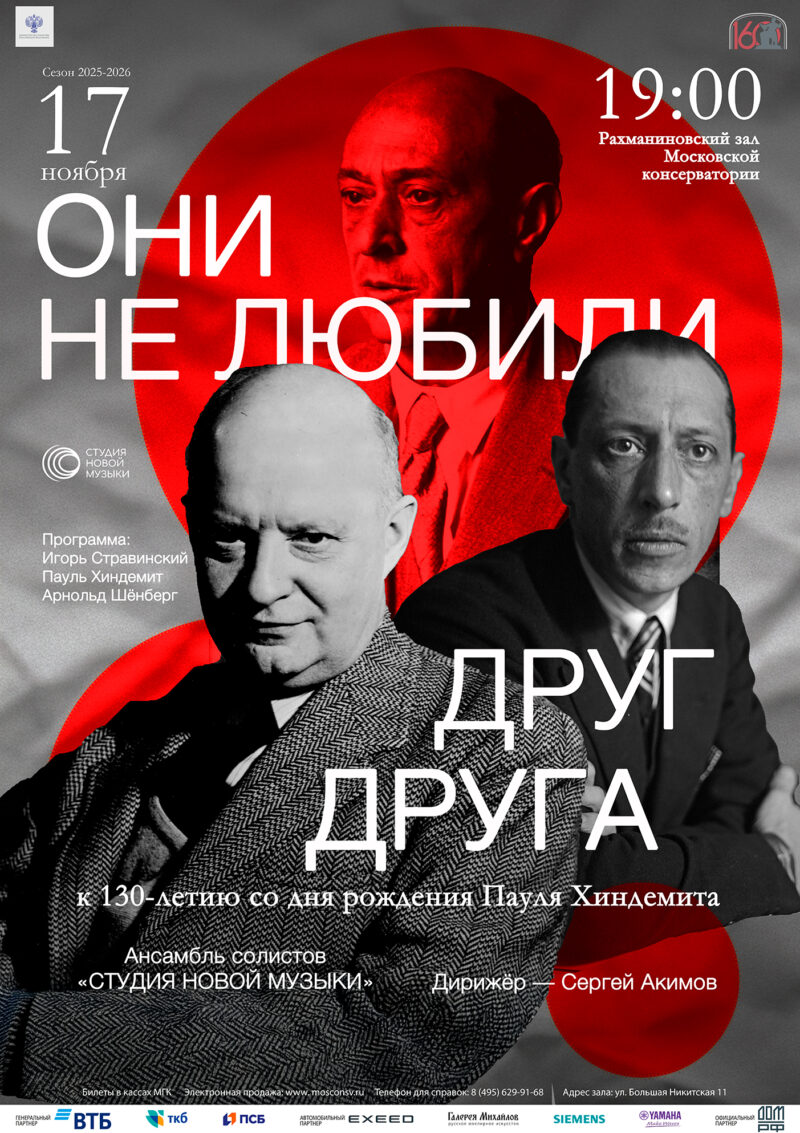

Concert for the 130th anniversary of the birth of Paul Hindemith
By the beginning of the twentieth century, with the end of the Romantic era, the three-century reign of classical harmony had also come to an end. Seeking to free themselves from the weight of nineteenth-century clichés, artists of different individualities embarked on new searches, taking as their stimulus the art and traditions of pre-Romantic eras.
In that pivotal century, an awareness of the crisis of European music and attempts to find a way out of it brought together three innovative composers: Paul Hindemith, to whom the anniversary concert is dedicated, Igor Stravinsky and Arnold Schoenberg. Despite this shared aspiration, their relationships were complex and contradictory, shaped not only by sharp aesthetic struggle but at times by personal rivalry.
Hindemith believed that the cause of the crisis lay not in the sphere of compositional technique but deeper, in the realm of ethics; it could therefore be overcome only through moral self-improvement. Hindemith sought a philosophical foundation in the music of the past, in particular that of the Middle Ages. And, like the medieval masters, he himself demonstrated in his art the unity of the craft, the technical and the creative, the fusion of “supreme creative power and supreme spiritual humility”.
Stravinsky overcame the crisis by passing the heritage of the past through his own consciousness and building a distinctive dialogue with it. With a gambler’s zest he selected and combined materials, took on technical problems, juxtaposed styles and imitated them.
But perhaps the most radical task was set by the head of the New Viennese School, Arnold Schoenberg, who, on the basis of the experience of the past, created a new system of musical thinking — dodecaphony — which many perceived as a break with tradition, as a negation of the entire preceding musical heritage.
Programme:
Paul Hindemith
Kammermusik No. 1
Kleine Kammermusik for wind quintet (1922)
Igor Stravinsky
“Jeu de cartes”
Arnold Schoenberg
Five Pieces for Orchestra, Op. 16