
The “Manifestos” Concert Series
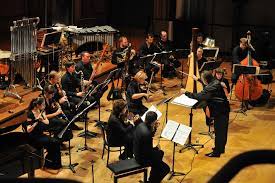
In 2024 the Studio for New Music soloists ensemble presented the “Manifestos” concert series. Curator – Fyodor Sofronov.
About the series
The manifesto is a form of art’s other-being. Why does an artist need words? Perhaps they are necessary at moments of crisis, when the artist’s intention cannot be perceived otherwise. The first manifesto of the modern era belongs to the realist painter Gustave Courbet (1855), who decisively broke with the academicians and believed that “painting can consist only in the representation of real things”. Anti-academic tendencies also influenced the formation of new groups, such as the Peredvizhniki (Wanderers) and the “Mighty Handful” in Russia. But the manifesto truly flourished in the 20th century, a time of global social and cultural transformations. At the beginning of the century noise took the place of instrumental sounds, and the Romantic aesthetic gave way to the simplicity of street art. New artistic forms came with the post-war period, 1968 and the era of the digital revolution. The manifestos that accompanied artistic innovations form a special domain of 20th-century art. They are an attempt to convey in words what can only be expressed by musical means — a gesture of despair on the one hand, and of resolve on the other.
“The Art of Noises”, 17 March, Rachmaninoff Hall
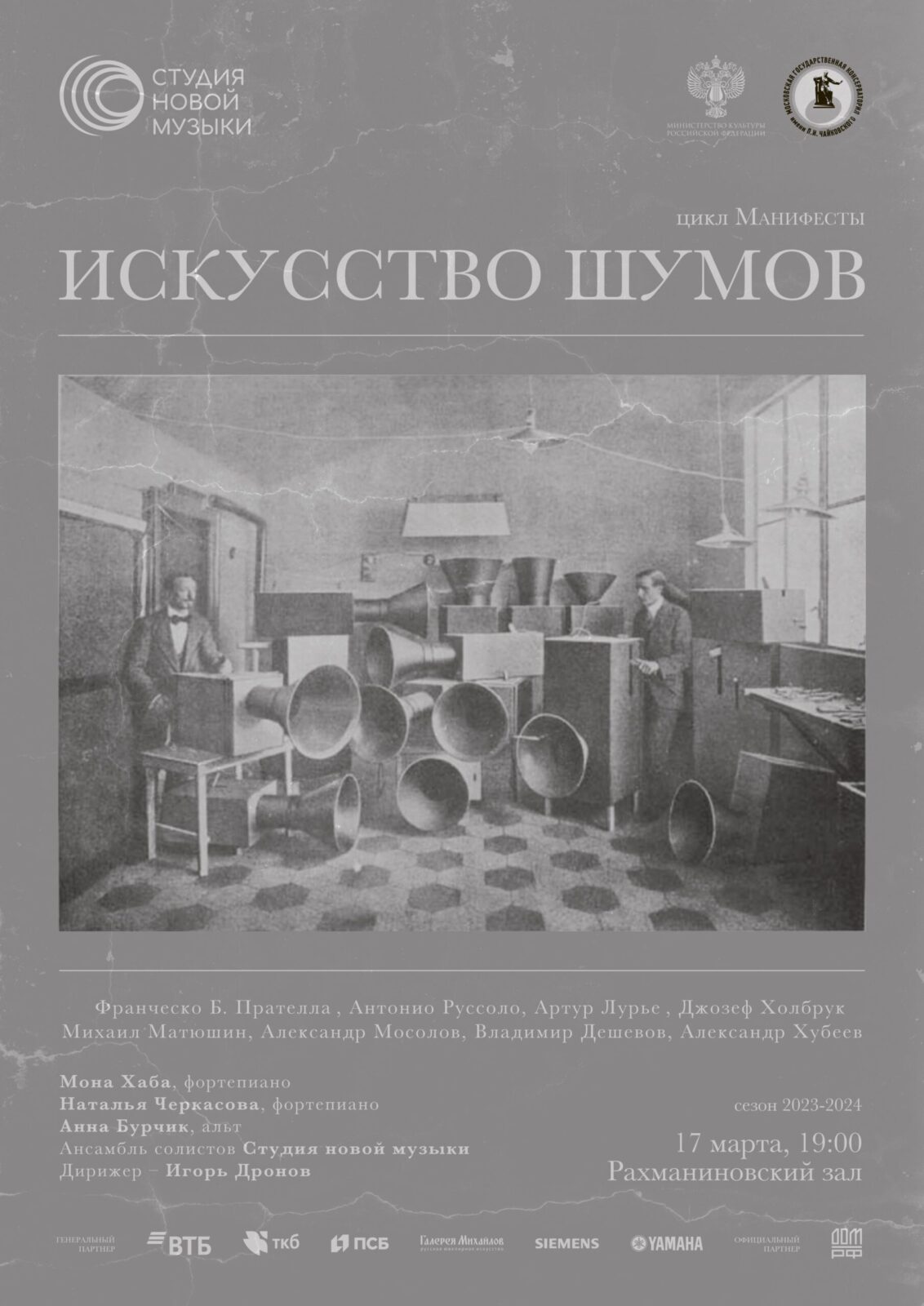
The early 20th century was a time of social catastrophes and, at the same time, of a creative and intellectual explosion, when people dreamed of a new world and a perfect culture. It was an era of technical inventions and high speeds, which inspired artists to create art commensurate with its scale. The sounds of the industrial world entered musical space, giving rise to Futurism. In the USSR its representatives were Arthur Lourié, Mikhail Matyushin, Alexander Mosolov and Vladimir Deshevov; in Italy, Francesco Balilla Pratella and Luigi Russolo, who constructed the intonarumori noise instruments and wrote the famous manifesto “The Art of Noises”. Each of them forged his own path towards the art of the future. The ideas of that time were called utopian,
but many of them are still alive today. Futurist experiments gave rise to musique concrète, sound art, noise and the explorations of today’s composers, as, for example, in Alexander Khubeev’s piece Intonarumori, which was also performed in the first programme of the series.
“Lecture on Nothing”, 17 May, Rachmaninoff Hall
The second concert of the series took its title from John Cage’s famous “Lecture on Nothing”, whose text is organised according to musical laws. Cage himself did not write manifestos, as his followers – members of the Fluxus movement – did. Yet the very work of the composer and of those who worked with him in New York in the late 1940s and early 1950s at the forefront of the world avant-garde can be regarded as a manifesto. Programme: John Cage, Earle Brown, Morton Feldman.
“Spectres and Sprites”, 23 June, Rachmaninoff Hall
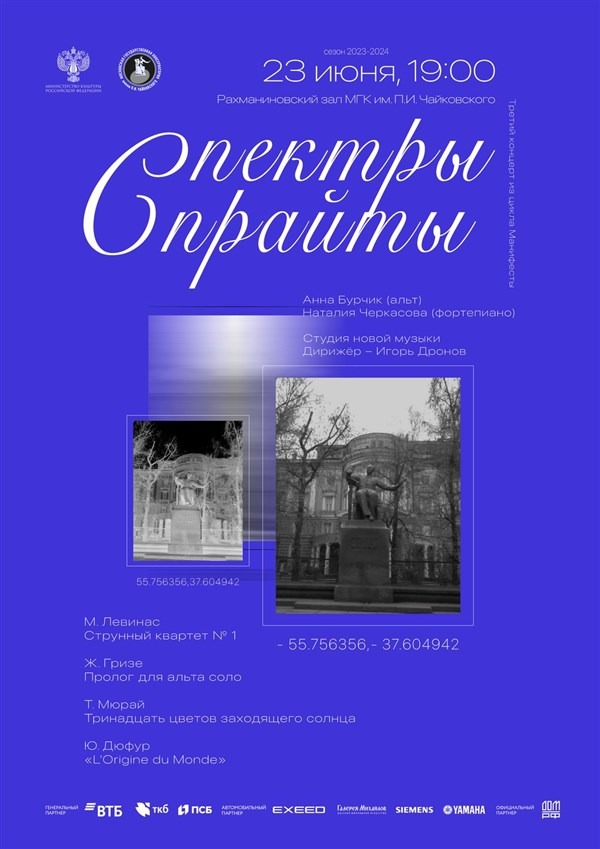
The third programme of the series was devoted to spectralism, a movement that emerged half a century ago in France and still influences art music today. The concert shares its title with an article by Tristan Murail, in which the composer speaks of the music of the future and the present, linked to a different attitude to sound. The spectralists believed that sound is not a neutral material but a living organism within which complex natural processes take place. The composers studied it with computers, as if under a microscope, breaking the universe-molecule down into atoms and reassembling it, recreating the spectrogram in the sound of the orchestra. The result was infinitely diverse scores. For just as no two people have the same pattern of lines on their palms, there are no sounds with identical spectra. The programme featured works by four composers of the spectral school, members of the group “l’Itinéraire”: Gérard Grisey, Tristan Murail, Hugues Dufourt and Michaël Levinas.
“Towards New Shores”, 17 September, Rachmaninoff Hall
The title of the concert, “Towards New Shores”, is the same as that of the journal of the Association for Contemporary Music (ACM). This organisation was founded in the USSR in 1924. Its members included Dmitri Shostakovich, Nikolai Myaskovsky, Alexander Mosolov, Nikolai Roslavets and other figures engaged in the search for a new musical language, who sought to promote the works of their contemporaries and to build bridges with colleagues abroad. Unfortunately, the ACM was short-lived: in the early 1930s the association was declared “a gathering of musicians alien to proletarian ideology” and dissolved. For the next several decades any manifestation of the new and unconventional in art was harshly suppressed. Fearing repression, some members of the Association left the country, while others chose the path of internal emigration. In the early 1990s, in the period of perestroika and glasnost, the need arose to create a new Association for Contemporary Music. Thus ACM-2 came into being, following the course of its predecessor. It was headed by Edison Denisov, who had the courage to unite dissenting young composers. More than thirty years have passed since the first joint performance of the ACM-2 composers. Many members of the original group have scattered across the world, and some are no longer alive. And contemporary music, as it was understood at the end of the 20th century, is gradually becoming classical. Programme:
Nikolai Roslavets, Alexander Mosolov, Leonid Polovinkin, Vladimir Zhivotov, Edison Denisov, Dmitri Smirnov, Victor Ekimovsky, Alexander Vustin.
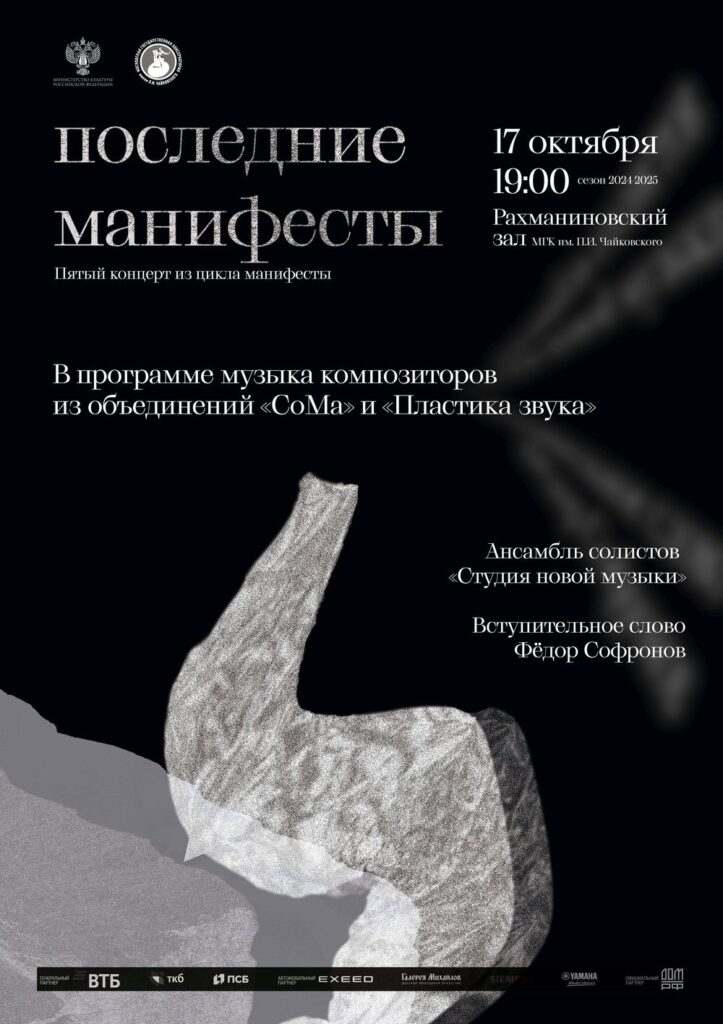
“The Last Manifestos”, 17 October, Rachmaninoff Hall
The programme of the lecture-concert “The Last Manifestos” included works by composers who belonged to the groups “SoMa” and “Plasticity of Sound”. Among them are leaders of today’s contemporary music scene: Olga Bochikhina, Vladimir Gorlinsky, Alexey Sioumak, Sergej Newski, Boris Filanovsky and others. The programme texts of SoMa and Plasticity of Sound were the last manifestos of Russian composers in the past 20 years. The programme concluded the “Manifestos” series, in which the ensemble’s soloists, together with the lecturer Fyodor Sofronov, explore the artistic innovations of the 20th and 21st centuries and the phenomenon of the manifesto as a form of art’s other-being.