
A lecture by Marianna Vysotskaya 4 October, Saturday | 16:00 What is the musical avant-garde, and how does it fit into the broader artistic processes of the 20th century? What are its criteria, features and aesthetic programme? Does it intersect with the tendencies and language of related arts? Was the avant-garde in music a single monolithic movement with a style of its own, or is it more accurate to speak of a phenomenon of “many colours” – a multitude of…
READ MORE
Lecture by Marianna Vysotskaya In Search of a New Sound: Sonoric Composition How It Is Made In the second half of the twentieth century the sonoric technique of composition came to the fore. The newest music displays manifold embodiments of the sonoric idea: from a timbral treatment of serial structures to musical stochastics, from prepared piano to extended piano, from “composing” timbre by revealing the spectral characteristics of sound to timbral synthesis within mixed-type composition. Innovative composers, with varying degrees…
READ MORE
F. M. Sofronov From Noise to Electronic Composition A System of Coordinates Unlike the music of past centuries, contemporary music does not use “ready-made” schemes of composition and its elements. Each composer develops his own musical language from peculiar “formants” that he invents himself. The sound designer, who selects and processes sounds for a future soundscape, does something similar. The essential differences between the soundscape and opus music have recently been blurring under the powerful influence of multimedia and now…
READ MORE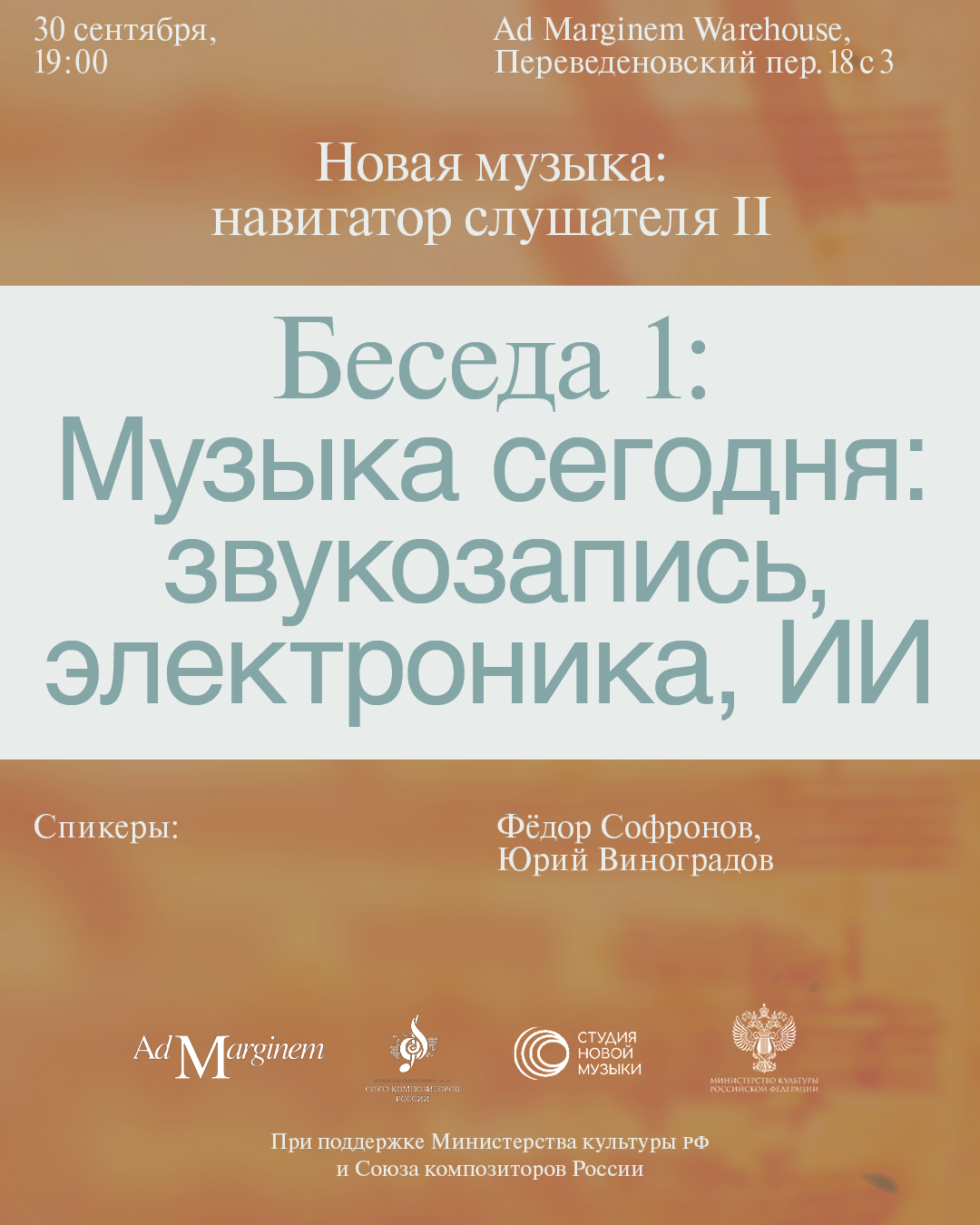
Talk I. Music Today: Sound Recording, Electronics, AI. A conversation between Fyodor Sofronov and Yuri Vinogradov What happens to art when distance disappears? The first public talk of the project “New Music: A Listener’s Guide II”, timed to the publication of Theodor Adorno’s books on music Walter Benjamin wrote about the “aura” of a work — that special distance separating it from everyday life, tied to the remnants of its cult function. Technical reproducibility shortens this distance, and today’s streaming…
READ MORE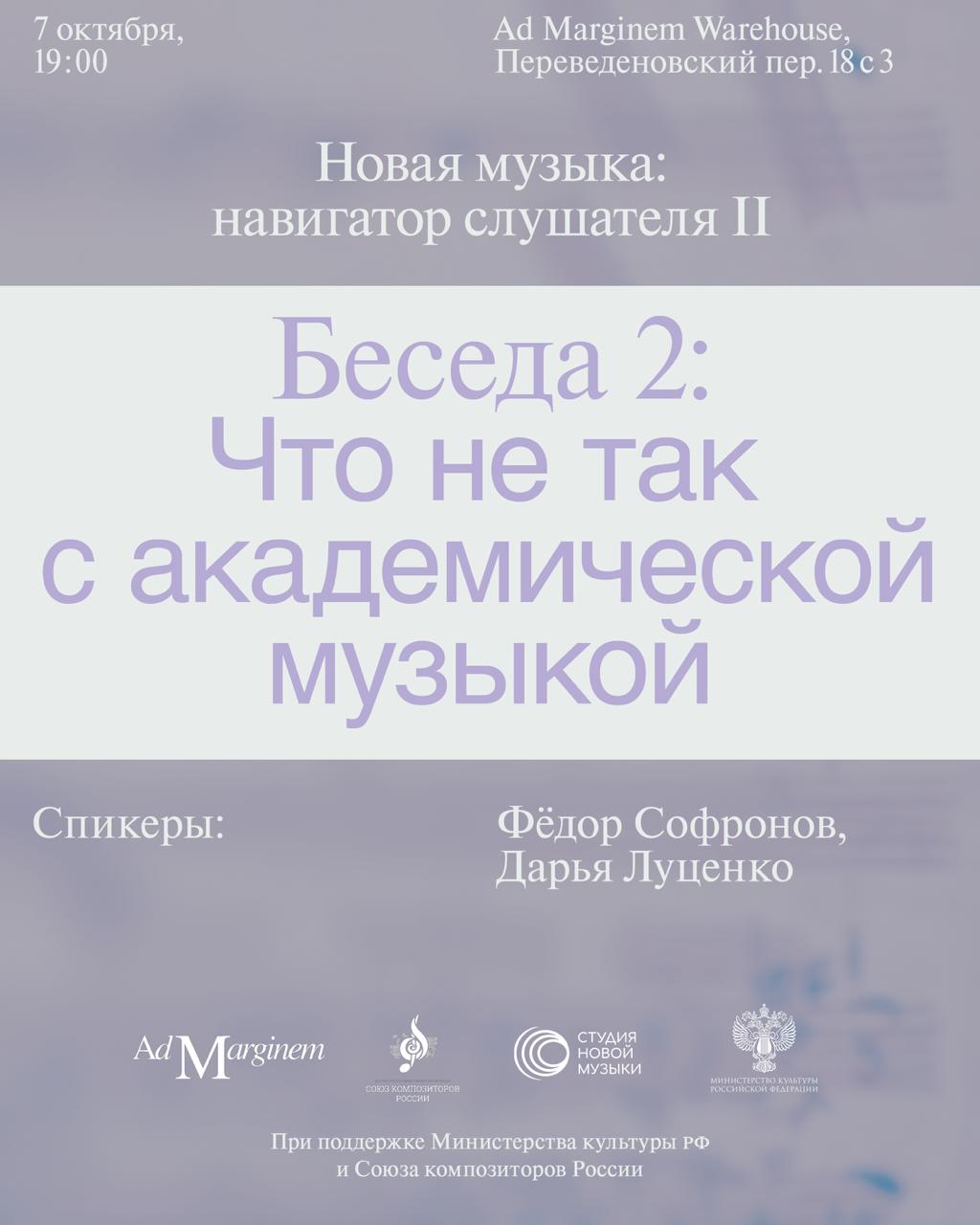
The second public talk of the project “New Music: A Listener’s Guide II” Why is contemporary academic music so often perceived as an art “not for everyone”? Who is addressed by a work that deliberately renounces the usual means of expression and demands that the listener know the context and be able to hold attention where the musical language “resists” perception? Entering popular music is much easier: fewer conditions are needed for perception, less prior knowledge is required, and there…
READ MORE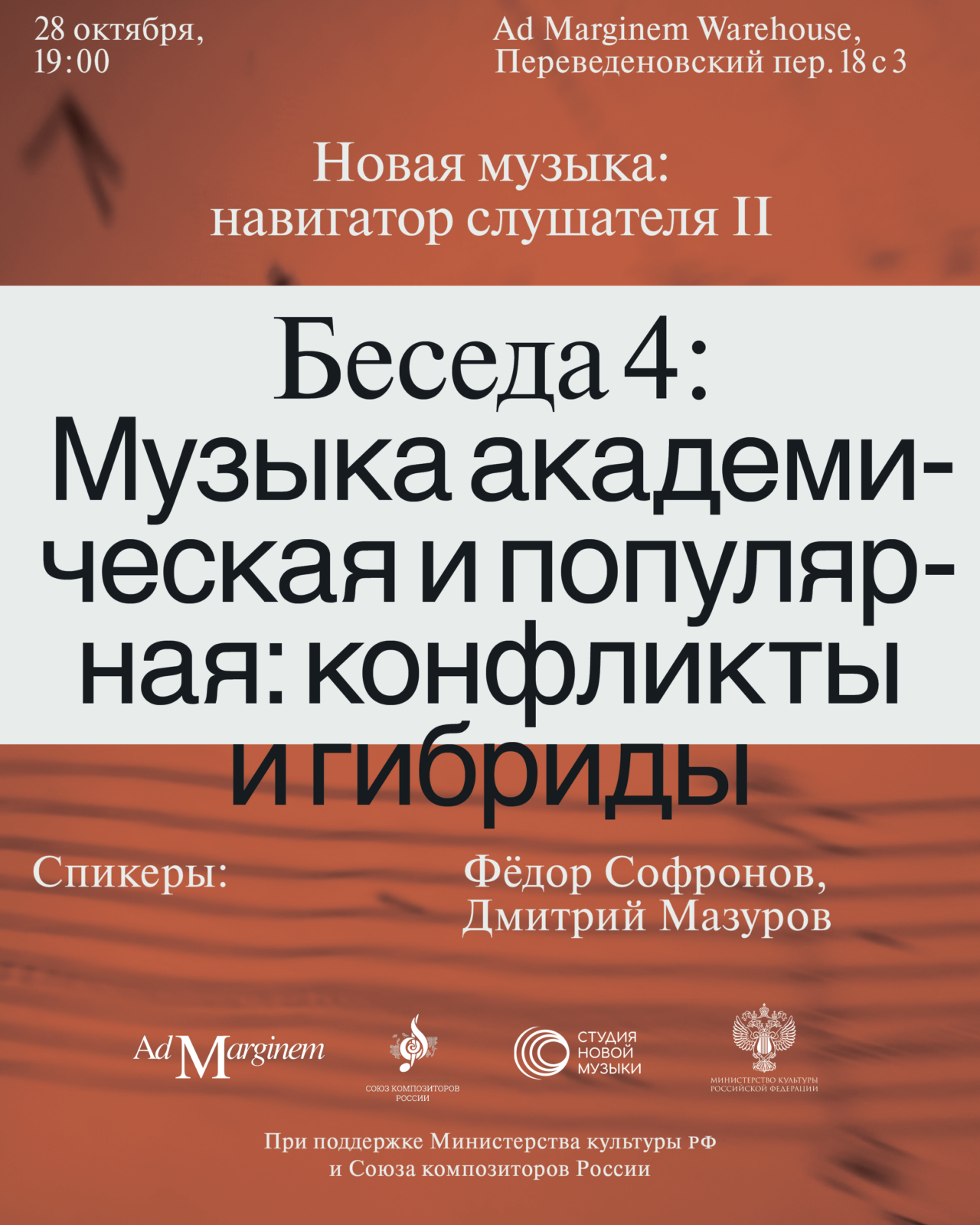
The fourth public talk in the “New Music: A Listener’s Guide II” project, marking the publication of Theodor Adorno’s books on the sociology and philosophy of music In Martin Scorsese’s “Shutter Island,” music by avant-garde composers Giacinto Scelsi and Morton Feldman — whose works are rarely performed outside concert halls — becomes part of the cinematic language and an element of popular culture. The interaction between classical and popular music occurs not only in cinema, but also in the treatment…
READ MORE