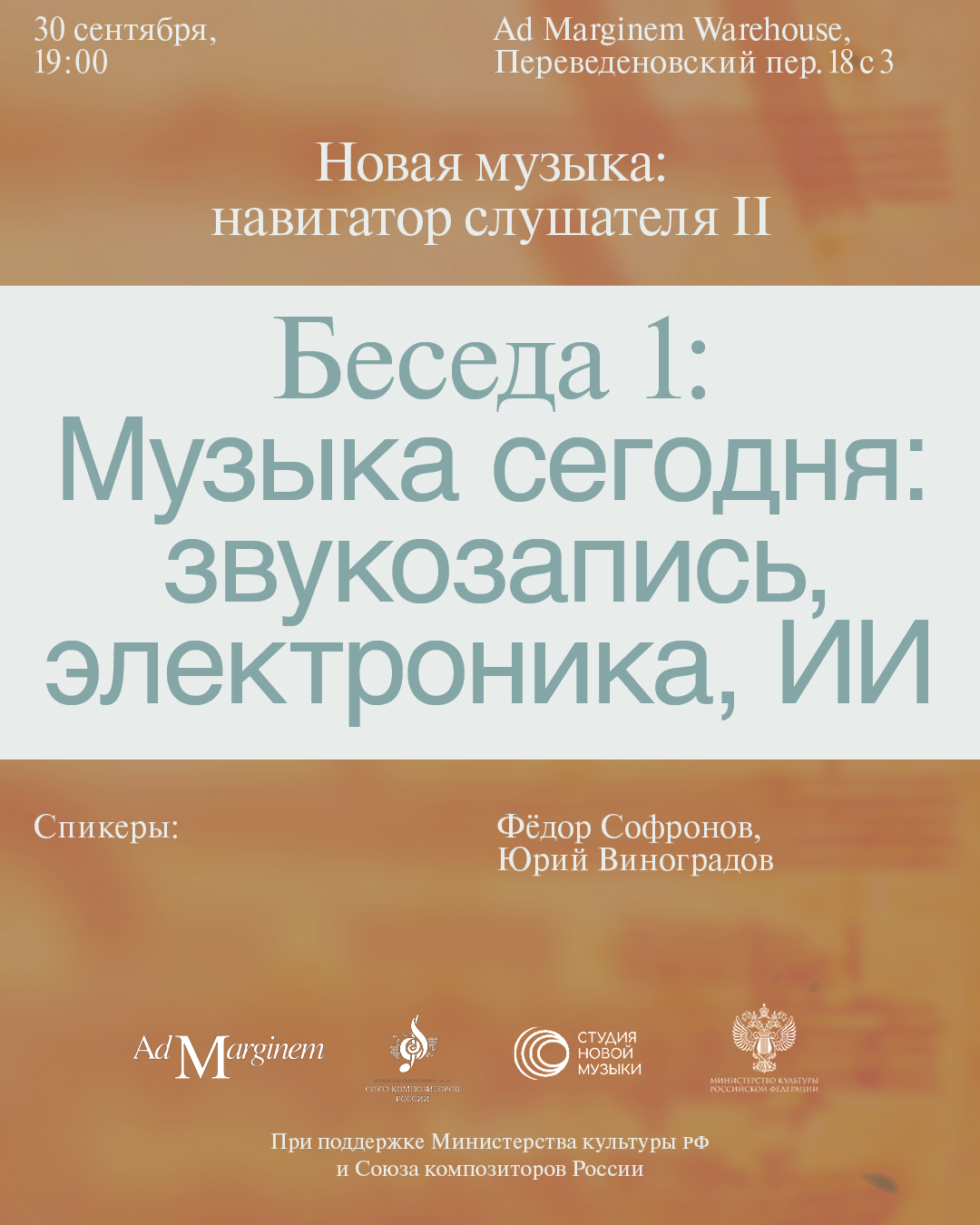

Talk I. Music Today: Sound Recording, Electronics, AI.
A conversation between Fyodor Sofronov and Yuri Vinogradov
What happens to art when distance disappears?
The first public talk of the project “New Music: A Listener’s Guide II”, timed to the publication of Theodor Adorno’s books on music
Walter Benjamin wrote about the “aura” of a work — that special distance separating it from everyday life, tied to the remnants of its cult function. Technical reproducibility shortens this distance, and today’s streaming services take the process to the limit: the entire history of music ends up in a single interface, where Mahler, Coltrane and dance-pop hits sit side by side, and works created in different historical and cultural contexts become part of one endless stream.
But does the aura disappear altogether — or does it simply move to a new object? Before sound recording, this value belonged to live performance here and now — a particular concert that cannot be repeated; now this status goes to a specific recording, such as Gould’s “Goldberg Variations”, while music as a whole turns into something like a grand museum in which eras and styles coexist, neither absorbing one another nor preserving their original context.
The boundary between listener and author has changed as well. Home studios, digital instruments, sampling, and now AI have made the production of music more accessible — and at the same time have continued the long process of separating music from the performer’s body, and now from the composer’s intent. What happens to art when it is not only the distance between the work and the listener that disappears, but also the former distance between professional and amateur, composer and algorithm? Is musical culture not turning into what Adorno called neutralization — a space where everything can coexist with everything else and therefore loses its own conflict and context?
Musicologist Fyodor Sofronov and philosopher Yuri Vinogradov will discuss this on 30 September at 19:00 at Ad Marginem Warehouse.