
DEPARTMENT OF CONTEMPORARY MUSIC
RESEARCH AND CREATIVE CENTRE FOR CONTEMPORARY MUSIC
OF THE MOSCOW CONSERVATORY
are holding an academic conference
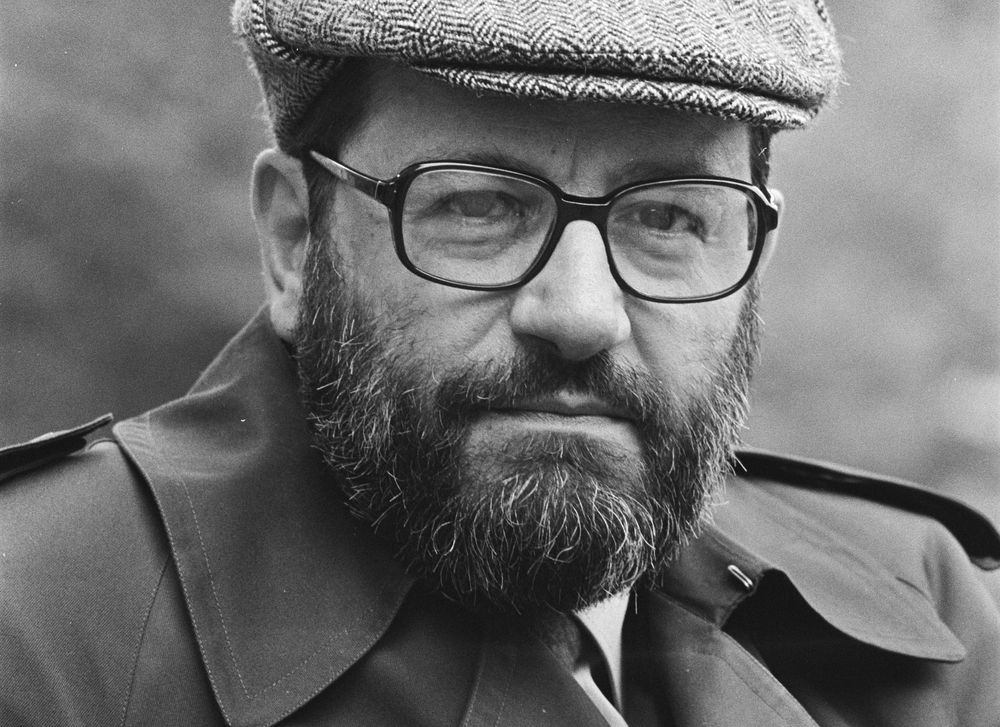
The “Echo” of Eco (1932 – 2027): on the 95th anniversary of the birth of the outstanding scholar
The conference will take place on 25 February 2027 in the Conference Hall of the Tchaikovsky Moscow State Conservatory (13/6 Bolshaya Nikitskaya St., Moscow).
The name of Umberto Eco brings to mind a towering mountain peak: over the course of a prolific academic career, the scholar addressed a wide range of questions and left a notable mark on a number of fields in the humanities. Of enormous importance for musical culture were such works by Eco as The Open Work (1962), which advanced the idea of the fundamental incompleteness of cultural objects and introduced the notion of the “open work” — one in which the creative role of the performer, as a genuine co-author, increases dramatically. In the monograph Apocalypse Postponed (Apocalittici e integrati: mass communications and theories of mass culture, 1964) the scholar discusses the problems of mass culture: “The Bond Affair”, “The Myth of Superman”. In A Theory of Semiotics (1975) and Semiotics and the Philosophy of Language (1984) Eco developed a semiotic concept according to which “cultural units” are “…the signs that social life has put at our disposal”. In the 1970s Eco turned to the problem of interpretation. The monograph The Role of the Reader (1979) introduces the notion of the “model reader”, aware of the many possible interpretations of a text. The scholar revised his early thesis of an infinite number of interpretations: they are numerous, but not infinite. The Limits of Interpretation (1990) refines his approach to the problem of interpretive freedom. An intellectual and a novelist, Eco is the author of seven novels that inspired not only writers and film directors but also twentieth-century composers. His broader cultural ideas are extremely important for contemporary music: without The Open Work the history of aleatory music would be incomplete, and his writings on popular culture give researchers a powerful tool for studying mass art.
Thematic areas of the conference include:
- U. Eco as a theorist of art (based on his published works)
- U. Eco and the musical avant-garde
- U. Eco and musical semiotics
- U. Eco and the concept of Opera aperta
- U. Eco and the problem of interpretation in music
- U. Eco and the theory of intertextuality
- U. Eco and the aesthetics of mass media
Musicians, musicologists, philosophers and cultural scholars are invited to take part.
RULES
Expected length of presentations: 30 minutes at the plenary session and 20 minutes at section sessions, plus 10 minutes for discussion.
The working languages of the conference are Russian and English.
Participation is free of charge; there is no registration fee.
Travel and accommodation expenses are not covered. A personal invitation to the conference can be sent on request.
Hotel reservation is possible (please indicate this in your application).
Applications must be sent by 25 January 2027 to: info@ccmm.ru.
Application form:
- Full name
- Academic degree (if any)
- Academic title (if any)
- Place of work or study (full official name)
- Position
- Paper title (in Russian or English)
- Keywords (in Russian or English, 5 to 7 words)
- Abstract (in Russian or English, 250–300 words)
- Form of participation (in person or online)
- Technical equipment required for the presentation
The organising committee reserves the right to select papers on a competitive basis.
Speakers will have the opportunity to publish their papers in one of the peer-reviewed journals recommended by the Higher Attestation Commission (VAK):
• Scholarly Bulletin of the Moscow Conservatory (Nauchny vestnik Moskovskoy konservatorii)
• Journal of the Society for Music Theory (Zhurnal Obshchestva teorii muzyki)
• Musical Art of Eurasia. Tradition and Modernity