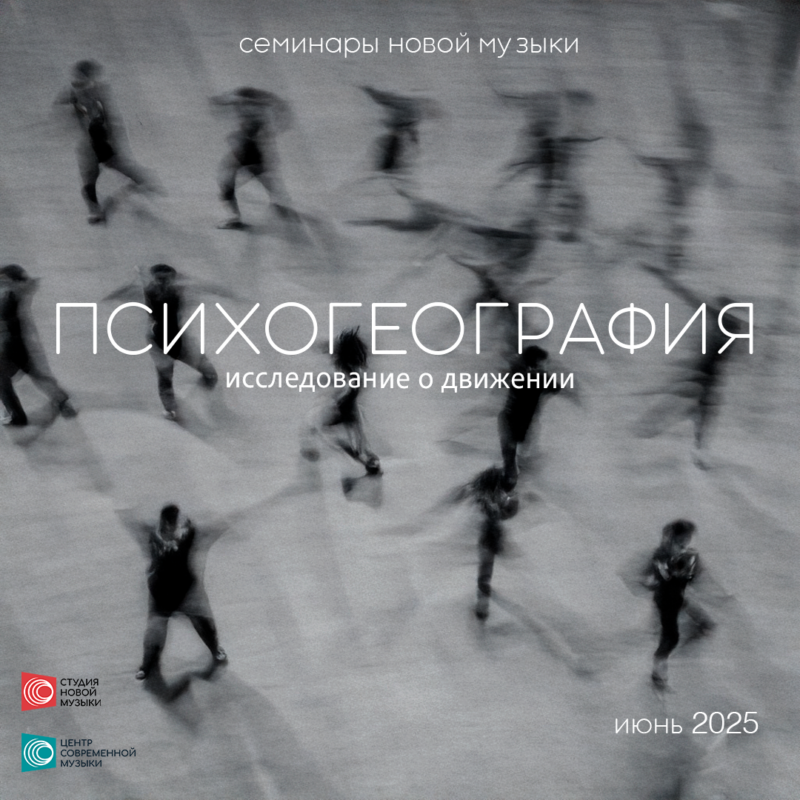

5th All-Russian Seminars of New Music
PSYCHOGEOGRAPHY: A STUDY OF MOVEMENT
10–15 June
Moscow Conservatory
The Studio for New Music ensemble and the Centre for Contemporary Music of the Moscow
Conservatory are holding the All-Russian Seminars of New Music for the fifth time. Over
the life of the project, more than 100 young composers, performers and conductors from different regions of Russia have taken part,
including Moscow, Yekaterinburg, Yelets, Kazan, Krasnodar, Magnitogorsk, Nizhny
Novgorod, Rostov-on-Don, Saratov, Ufa and others.
The 5th Seminars are held under the general theme “Psychogeography: A Study of
Movement” and are organised as a laboratory for creating and realising musical
performances in collaboration with a group of directors and actors — graduates of
MIR-7.
Young composers and performers under the age of 35 are invited to take part. The curator of the seminars will be the composer and Associate Professor of the Moscow
Conservatory Olga Bochikhina.
Applications are accepted until 20 May.
Registration for composers
Registration for performers
Registration for performance artists
About the theme of the seminars
The creative research and practices planned for the seminars go back
to ideas voiced in the mid-20th century by French philosophers and sociologists, the
Situationists. Thanks to them a new field — psychogeography — emerged,
within which the interaction of people, space and architecture was studied.
The Situationists believed that the urban environment consists of changeable atmospheres flowing
into one another. “Drifting” along spontaneous routes, they explored these
atmospheres and tried to understand how different geographical environments affect
people’s emotions and behaviour.
Psychogeography makes it possible to see familiar places from another side. At the Seminars
composers and performers will be invited to look differently at ready-made
architectural forms and to think of them in terms of sound and performative
practices.
Working on projects together with the group of directors and actors, participants will turn
to two elements of contemporary urban space. The first is
the elemental force of movement that fills the Big City. Movement is an integral
component of our existence in space. It is linked with life
energy — it is what keeps the blood flowing. It is also linked with musical
energy — for sound always exists in motion.
The second element is the crossroads, a place of meeting that brings different movements into collision,
stops them, receives them, mixes them and
transforms them. Olga Bochikhina: “This is a story about the connection between the banks of a river and its
flow, which never ceases its movement. This is a story about
labyrinths, corridors, bridges, circles of various literary texts that can
unexpectedly come to life in unexpected architectural settings.
For example, under the vaults of the second-floor promenade of the Small Hall of the Conservatory.
The form of circular movement and Dante’s circles and spheres: where and how can they
meet? This is a game of movement and of the crossroads, where
parallel universes coexist — this is the Game Universe.”
Public programme
Tuesday, 10 June
Room 106
of the Moscow Conservatory
14:00
Daria Lutsenko
The Art of Musical Performance: Body and Sound
The performing art of the 21st century includes many different practices in which the musician “steps out” beyond the text of the work and its reproduction.
The conceptual nature of contemporary scores demands multitasking, in particular because of the synthesis of different genres and art forms. Performance involves
many parameters directly reflecting the conceptual component. Instrumental theatre, improvisation and performance are already
familiar practices of our time. What is the unifying factor behind these phenomena in music? We will consider how various
concepts of musical performance can be realised, using examples of works for the theatre, chamber performances and electronic live sets.
Registration
16:00
Olga Bochikhina
The Sonic Turn and Contemporary Sound Practices
What does it mean to develop a sonic situation, to explore a sonic theme, to create a sound script? How can one bind together auditory experience, action, composition, channels of perception,
image and story? What does it mean to create and model a sounding and acting environment — self-generating and self-developing, with its own internal sonic laws and
game strategies? How can one open up the world of sound? I will share my reflections, inspired by the latest artistic projects I have taken part in: “Kafka in Athens”, “Sophia’s Sounding House” and my own course “The Experience of Sound” for actors, run as a joint programme of GITIS and the Stanislavsky Electrotheatre.
Registration
Wednesday, 11 June
Conference Hall of the Moscow Conservatory
11:00
Dmitry Mazurov
Creative Work at the Intersection of Academic and Popular Music
How can one combine distant forms of music and live in a creative double world? This is
a question not only of style but often of mutually exclusive audiences. By remaining
authentic to one culture, an author unwittingly becomes “vulgar” in another. Is it
possible to combine them in a situation where it could not have been otherwise? The composer Dmitry Mazurov will talk about his creative path
and method of work.
Registration
13:00
Fyodor Sofronov
The History of Musical Performance
From the practices of the Futurists and Dadaists to the American experiments of the 1960s — these are the boundaries within which we can speak of the emergence of musical
performance. The aim of the lecture given by Fyodor Sofronov is to talk about this history and about how performance has changed in historical
perspective.
Registration
Thursday, 12 June
Conference Hall of the Moscow Conservatory
13:00
Evgenia Izotova
New Music in Search of a New Notation
Musical notation has always developed in response to the demands of compositional practice,
adapting to new styles and techniques. The 20th century, with its radical experiments,
required a significant expansion and renewal of musical writing. And, to our
surprise, many “new” symbols, terms and phenomena turn out to be echoes of the
past. In the lecture we will see how composers of different eras arrived at similar
solutions, what parallel exists between the graphic music of Earle Brown and the scores of
the Late Middle Ages, and what the notation of new playing techniques
for wind instruments has in common with old lute tablature.
Registration
Friday, 13 June
Conference Hall of the Moscow Conservatory
11:00
Ignat Krasikov
Not by Notes Alone: Performance
Performance offers a rethinking of the traditional view of academic
music as the static text of a score. Performing is a complex and multifaceted
process in which music becomes an event shaped by the performer’s physicality,
spatial and communicative dynamics, and the context of
perception. We will consider the key concepts of performance in academic music,
analyse the influence of interpretation and non-verbal elements on the meaning of
a work, and trace how innovative practices of the 20th and 21st centuries transform
attitudes to the boundaries between composer, performer and listener.
Registration
13:00
Tatiana Yakovleva
Multi-, Inter- and Transmediality in Music
Music increasingly includes as media not only sounds but also gestures, video, light and
a wide variety of devices — specially created objects and musical instruments.
Composers develop different ways of connecting them, uniting
the technological and the acoustic, the human and the machine. In the lecture we will examine their
main properties, using examples of multimedia, intermedia and transmedia
works by composers of the late 20th and early 21st centuries.
Registration