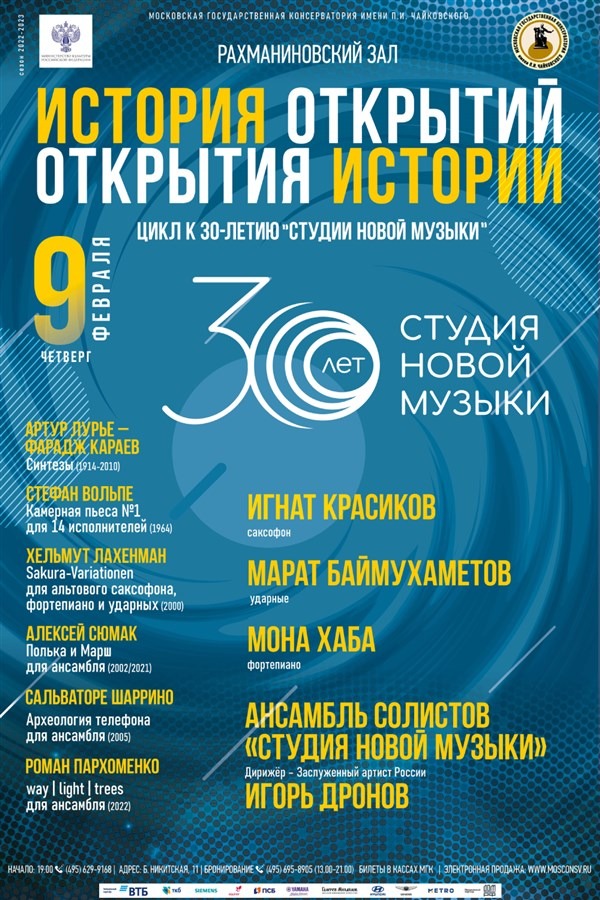

Programme:
Arthur Lourié — Faraj Karaev
Syntheses (1914 — 2010)
Alexey Sioumak
Polka and March for ensemble (2002/2021)
Helmut Lachenmann
Sakura-Variationen for alto saxophone, piano and percussion (2000)
Roman Parkhomenko
way | light | trees for ensemble (2022)
Stefan Wolpe
Chamber Piece No. 1 for fourteen players (1964)
Salvatore Sciarrino
Archeologia del telefono for ensemble (2005)
Performers:
Ignat Krasikov, saxophone
Marat Baimukhametov, percussion
Mona Khaba, piano
Studio for New Music ensemble
Conductor — Honoured Artist of Russia Igor Dronov
For 30 years now, the Studio has been building a repertoire that reflects the stylistic richness of new music and the historical continuity of its development. Alongside works already familiar to a wide audience, the ensemble performs:
➔ undeservedly forgotten and lost masterpieces of the first half of the 20th century;
➔ new opuses by young composers;
➔ works from the second half of the 20th century that are rarely heard in concert halls.
In its programmes the Studio has rediscovered the names of composers of the first Russian avant-garde: Efim Golyshev, Stefan Wolpe, Ivan Wyschnegradsky, Nikolai Obukhov and others. Many of them were struck out of official Soviet historiography for many years.
The Studio has given a number of unique, literally “historic” premieres. The ensemble was the first to perform masterpieces of the early Russian avant-garde: Nikolai Roslavets’s Second Chamber Symphony (1936), unknown scenes from Dmitri Shostakovich’s opera The Nose (1928), works by Wladimir Vogel and others.
Another important direction of the Studio’s work is collaboration with young composers. The ensemble gives master classes, lectures and seminars for students, commissions young composers and performs their works in Russia and abroad. Today the Studio’s repertoire includes several hundred such scores. The ensemble regularly takes part in international competitions for young composers and organises its own: the International Competition of the Moscow Conservatory and the International P. Jurgenson Competition.
In the Studio’s programmes Russian music is often placed in a global context and is heard alongside works by European, Asian and Latin American composers. Among the foreign composers are also those whom the ensemble introduced to Russian audiences for the first time: Fausto Romitelli, Gérard Grisey, Tristan Murail, Helmut Lachenmann, Brian Ferneyhough, Beat Furrer, Salvatore Sciarrino and many others.
For the Studio, 2023 is a time to take stock. The series “A History of Discoveries. Discoveries of History” will present the best “historical finds” that have enriched the ensemble’s repertoire over the past 30 years. Not resting on its laurels, the Studio continues to develop these directions and to look to the future. That is why, alongside opuses of the Russian and foreign avant-garde, the series will feature new pieces by young composers, including works written especially for the ensemble’s 30th anniversary.