
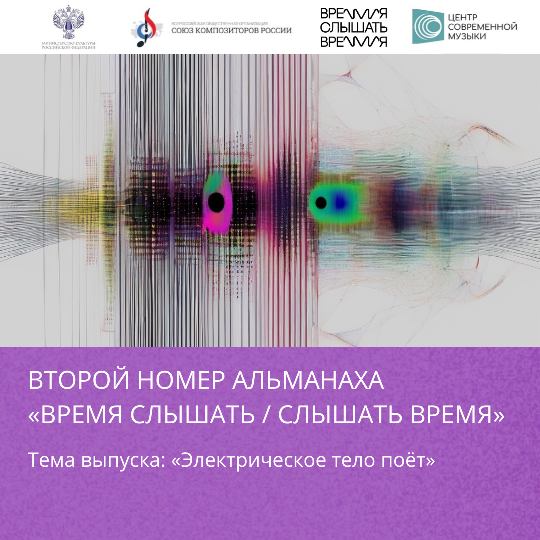
TIME TO HEAR / HEAR THE TIME
THE SECOND ISSUE OF THE ALMANAC ON NEW MUSIC
THEME OF THE ISSUE: “THE BODY ELECTRIC SINGS”
The second issue of the online almanac on new music “Time to Hear /
Hear the Time” is out. Continuing to explore the coordinates of the contemporary musical
landscape, in the issue entitled “The Body Electric Sings” the project team
invites readers to examine how composers and sound artists
interact with technology, and how electronic music – a term that
covers dozens of phenomena (acousmatic music, live electronics,
algorithmic music, soundscapes, multimedia, industrial, dubstep, noise
and more) – is developing in Russia’s capitals, in its regions and abroad.
The project is carried out by the team of the Centre for Contemporary Music of the Moscow
Conservatory with the support of the Union of Composers of Russia and the Ministry
of Culture of the Russian Federation.
The starting point of the issue is an essay by composer Anton Svetlichny on the path electronics has travelled – from an intriguing but not quite essential addition to the classical system of instruments to a source of the technological euphoria and mistrust in which today’s composer finds himself. The use of artificial intelligence in sound is discussed by the duo Gray Cake (Alexander Serechenko and Katya Pryanik) – artists, teachers of their own courses and co-founders of the “Technological Art” master’s programme at NUST MISIS. The use of electronic technologies in Tatar and Bashkir music is the subject of Farhad Bakhtiyari’s interview with composer, sound engineer and multi-instrumentalist Marat Fayzullin.
The theme of the issue is also addressed by the texts in the “Student Research” section – the essay “Art VS Computer Science: Reflections on the History of the Term ‘Multimedia’” by Diana Aksinenko, and notes by Anastasia Volobueva, an independent producer in culture and education, about what is happening in and around the School of Advanced Studies (SAS) of the University of Tyumen: in Tyumen, Zavodoukovsk, Siberia/the Urals, Russia and Europe.
The almanac’s pages also continue the “Older Generation” project, launched some time ago by the team of the Stravinsky.online portal with the support of the Union of Composers of Russia and intended to create a portrait of the masters of contemporary music. The hero of the second issue is the pianist and “chief performer of Cage in the USSR” Alexei Lubimov, who celebrates his 80th birthday this year. In an interview with Alyona Verin-Galitskaya, Lubimov talked about the Soviet period of his life, his tours, “revenge for Denisov” and Cage’s visit to the Soviet Union.
The second issue is rounded off by digests of events that took place over the past year in Russia and abroad. Among them are a review of educational laboratories of contemporary music by musicologist and host of the podcast “Violet Snow” Marat Ingeldeev; a review of the sound objects of the 2024 Venice Biennale by art historian Dina Yakushevich, a master’s student at Ca’Foscari University of Venice; and Anton Svetlichny’s report from the “Pictures at an Exhibition” festival in Nizhny Novgorod. Elina Andrianova, editor of the academic and critical journal Muzykalnaya Akademiya, sums up her personal impressions of years of work at a scholarly publication and shares a selection of articles on new music.
The “In the Studio” section, devoted to texts about the work of the Studio for New Music ensemble, now includes a review by musicologist and curator Sergey Terentyev of the concerts of the “Non-Obvious Intersections” project, held this summer at the new AZ/ART Centre for Contemporary Art.
Follow the updates on our website and social media (@studionewmusic)
