
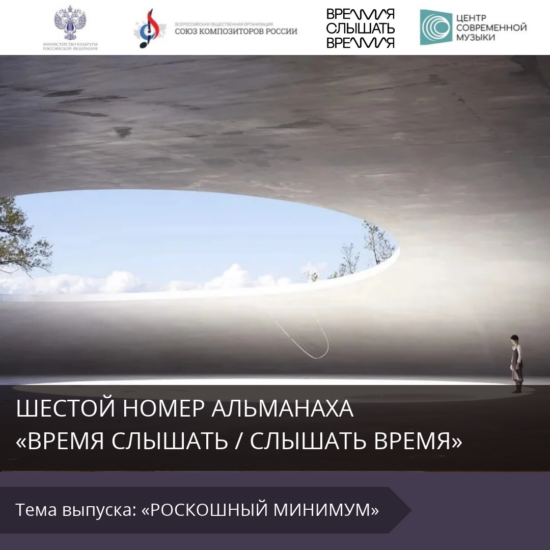
A sixth issue of the almanac of the Center for Contemporary Music, “Time to Hear/Hear Time”, has been published. Its central theme is musical minimalism: the history of its emergence and spread, its aesthetic principles, national characteristics and its influence on contemporary musical culture. The issue includes research, essays, interviews with composers, historical materials and a survey of representatives of contemporary academic music. Besides the main theme, the almanac turns to current events in the musical life of Russia and abroad, the philosophy of music and the history of Russian musical culture.
The almanac is published with the support of the Union of Composers of Russia and the Ministry of Culture of Russia
The theme of the issue is “The Luxurious Minimum”
The materials of the central section examine minimalism as an artistic movement whose boundaries and very definition remain a subject of debate.
In an essay on emptiness, the art historian Andrey Lomonosov explores the connection between Western minimalism and the Japanese aesthetic concept of “ma”. Daria Lutsenko turns to the prehistory of the movement and examines the use of repetition in music before minimalism emerged as a style in its own right. Kristina Agaronyan analyses the relationship of early minimalism to American experimental music and the legacy of John Cage.
A separate block is devoted to the history and further development of the movement. Nikolai Grunin writes about the life and work of Steve Reich, one of the founders of musical minimalism, whose 90th anniversary is marked this year. The material is accompanied by illustrations by the artist and composer Danya Fisko. In an interview with Oleg Sobolev, the American composer and musicologist Kyle Gann reflects on musical naivety, on creating in anxious times, and recalls his trip to Russia in 2002.
The Russian history of minimalism is the subject of Bogdan Korolyk’s “The Luxurious Minimum. The Works and Days of Repetitive Music in Russia”. The author traces the formation and the particular features of Russian repetitive music. Anton Svetlichny in his article “Wake up, Neo” explores the origins of contemporary neoclassicism and its relationship with minimalism. Kristina Sarkhanyants presents a personal playlist of works by nine postminimalists, demonstrating the diversity of musical practices that emerged after classical minimalism.
Yuri Vinogradov examines the philosophical aspect of the theme in his article “Doomed to Novelty”, devoted to the problems that minimalism poses to the philosophy of music.
The thematic section concludes with a survey prepared by Sofa Fokina. Composers, performers and researchers of contemporary music answer questions about the nature of minimalism, its historical significance, the aesthetics of repetition and the prospects for its development. Among the participants are Vladimir Martynov, Nastasia Khrushcheva, Sergei Zagny, Pyotr Aidu, Anton Svetlichny, Tatiana Yakovleva, Mikhail Dubov, Dmitry Mazurov and other representatives of the musical community.
New Music in Russia and Abroad
The section publishes an interview with the Argentine composer Fernando Garnero, prepared by Daria Lutsenko. The conversation is devoted to his artistic formation, the musical life of Buenos Aires, the European avant-garde and the uneven access to contemporary academic music in different countries.
Several publications are devoted to the International Academy of Young Composers in the town of Tchaikovsky. In the essay “Engineers of Friendship”, Nastya Volobueva considers the Academy as a space of professional and human communication. The section is complemented by interviews with the N’Caged ensemble and the composer Alexander Hubeev, as well as a material based on a public talk with the musicologist Yaroslav Timofeev, “A Musicologist Is Polyamorous”.
In the article “Dangerous Liaisons”, Anatoly Malinkin and Ilya Bogomolov sum up the results of the IX “Pictures at an Exhibition” festival in Nizhny Novgorod.
Philosophy of Music
In a new material of the historical and philosophical cycle “Thinking Music”, Yuri Vinogradov turns to the musical thought of the Renaissance. The article is devoted to the changing ideas of music, its effect on man, and the relationship between mathematical regularities, sensual pleasure and human passions.
The Older Generation
The hero of the section is the musicologist Anatoly Tsuker, one of the first graduates of the Rostov Conservatory, a researcher and a direct witness of the formation of the musical life of the South of Russia. In an interview with Alyona Verin-Galitskaya he talks about his professional biography, the history of the conservatory and the musical environment of the late Soviet period.
The new issue continues the almanac’s work of studying contemporary music, its history, aesthetics and its connections with other fields of the humanities.
The full version of the issue is available free of charge on the website: https://timetohear.ru/
The almanac’s Telegram channel: https://t.me/time_to_hear
Editor-in-chief: Maria Nevidimova
Executive editor: Alina Moiseeva
Website editor: Gleb Chuchalin
Telegram channel editor: Danila Matrosov