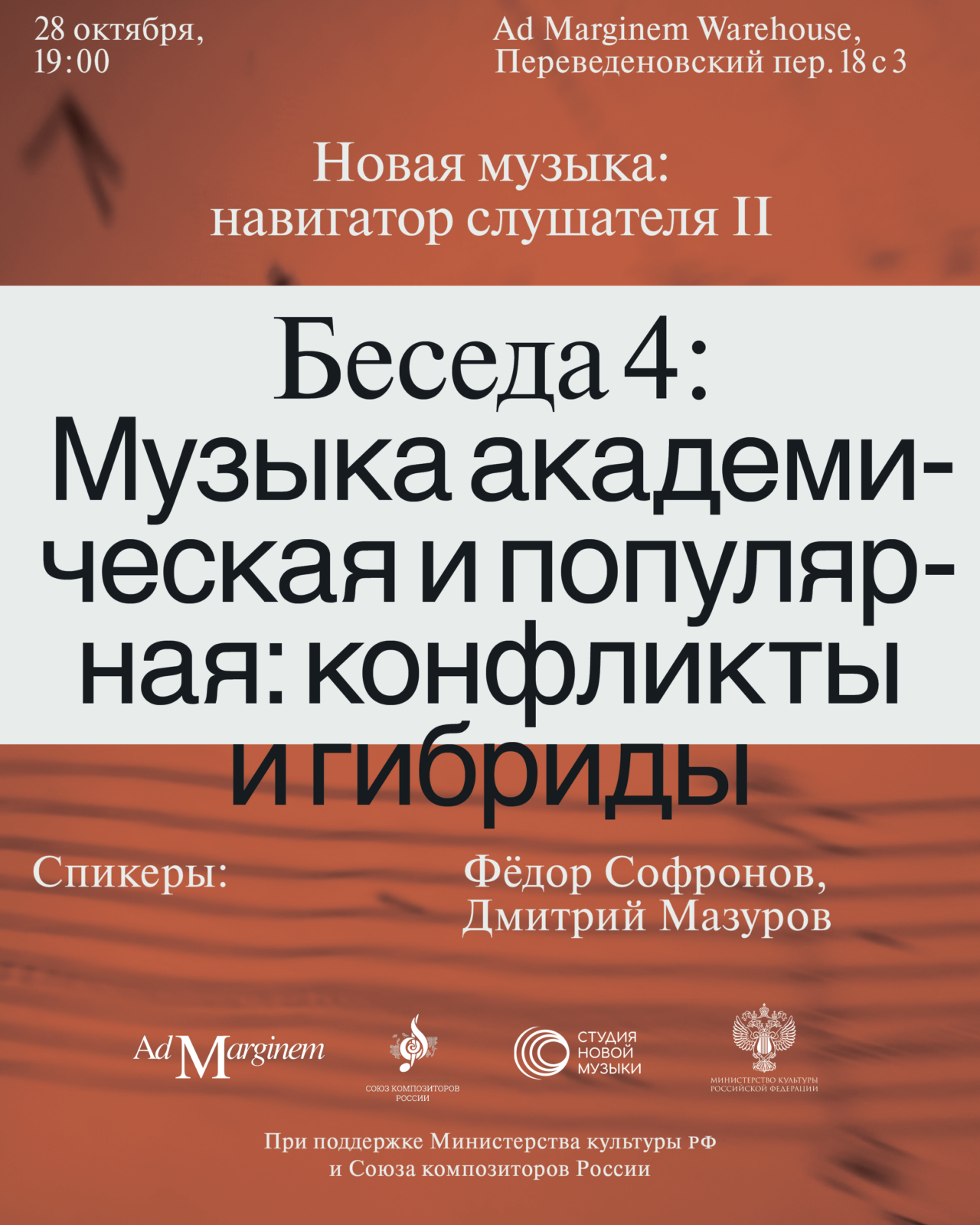

The fourth public talk in the “New Music: A Listener’s Guide II” project, marking the publication of Theodor Adorno’s books on the sociology and philosophy of music
In Martin Scorsese’s “Shutter Island,” music by avant-garde composers Giacinto Scelsi and Morton Feldman — whose works are rarely performed outside concert halls — becomes part of the cinematic language and an element of popular culture.
The interaction between classical and popular music occurs not only in cinema, but also in the treatment of musical material itself. Musique concrète emerged in France in the 1940s: composers worked with recordings of everyday sounds, transforming them through editing and processing into musical works. Related techniques are used in electronic music today: the American duo Matmos creates compositions from the sounds of medical instruments and procedures, while the British duo Coldcut combines field recordings with electronic beats. Sound experiments have become part of contemporary club culture, although their academic origins often go unnoticed.
However, borrowing musical techniques does not necessarily bring aesthetic positions closer together. In 1995, Karlheinz Stockhausen was invited to listen to tracks by Aphex Twin, Plastikman, and Scanner — musicians working with electronic sound, repetitive rhythms, and gradually changing sonic textures. For Stockhausen, who was critical of mechanical repetition in music, this was an encounter with a fundamentally different understanding of musical time. What might seem monotonous in one aesthetic became the foundation of the musical process in another. This encounter raised the question: what exactly do we value in music — development, novelty, complexity, or the experience of sound and time itself?
At the fourth public talk, musicologist Fyodor Sofronov and composer and sound producer Dmitry Mazurov will discuss the conflicts and mutual influences of classical and popular music: what happens to a work when it changes context, and whether musical hybrids overcome the boundaries between academic and popular music — or merely make those boundaries more visible.
→ October 28, 19:00, Ad Marginem Warehouse (Moscow, 18 Perevedenovsky Lane, Building 3).
The project is supported by the Union of Composers of Russia and the Ministry of Culture of the Russian Federation.